
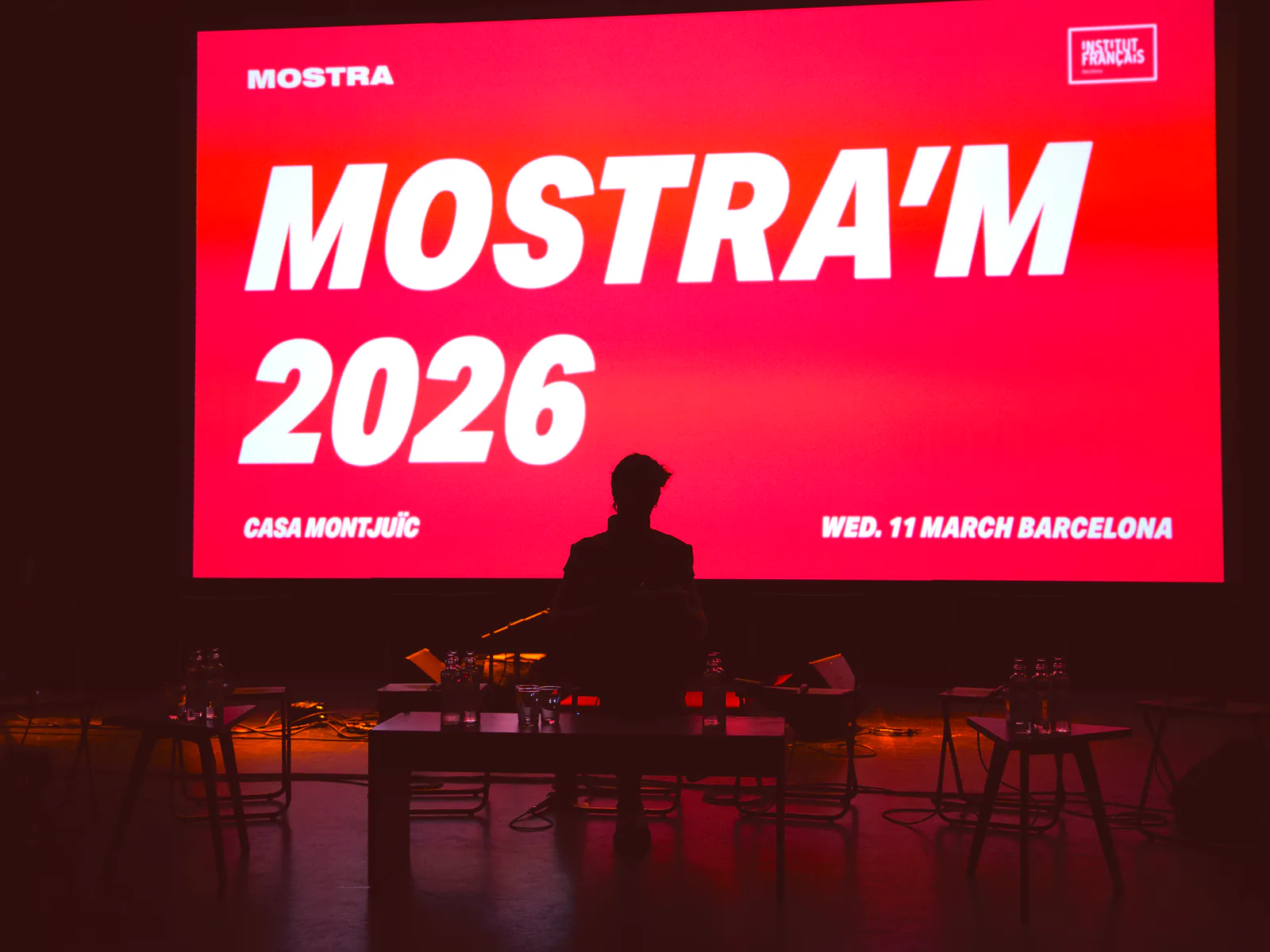
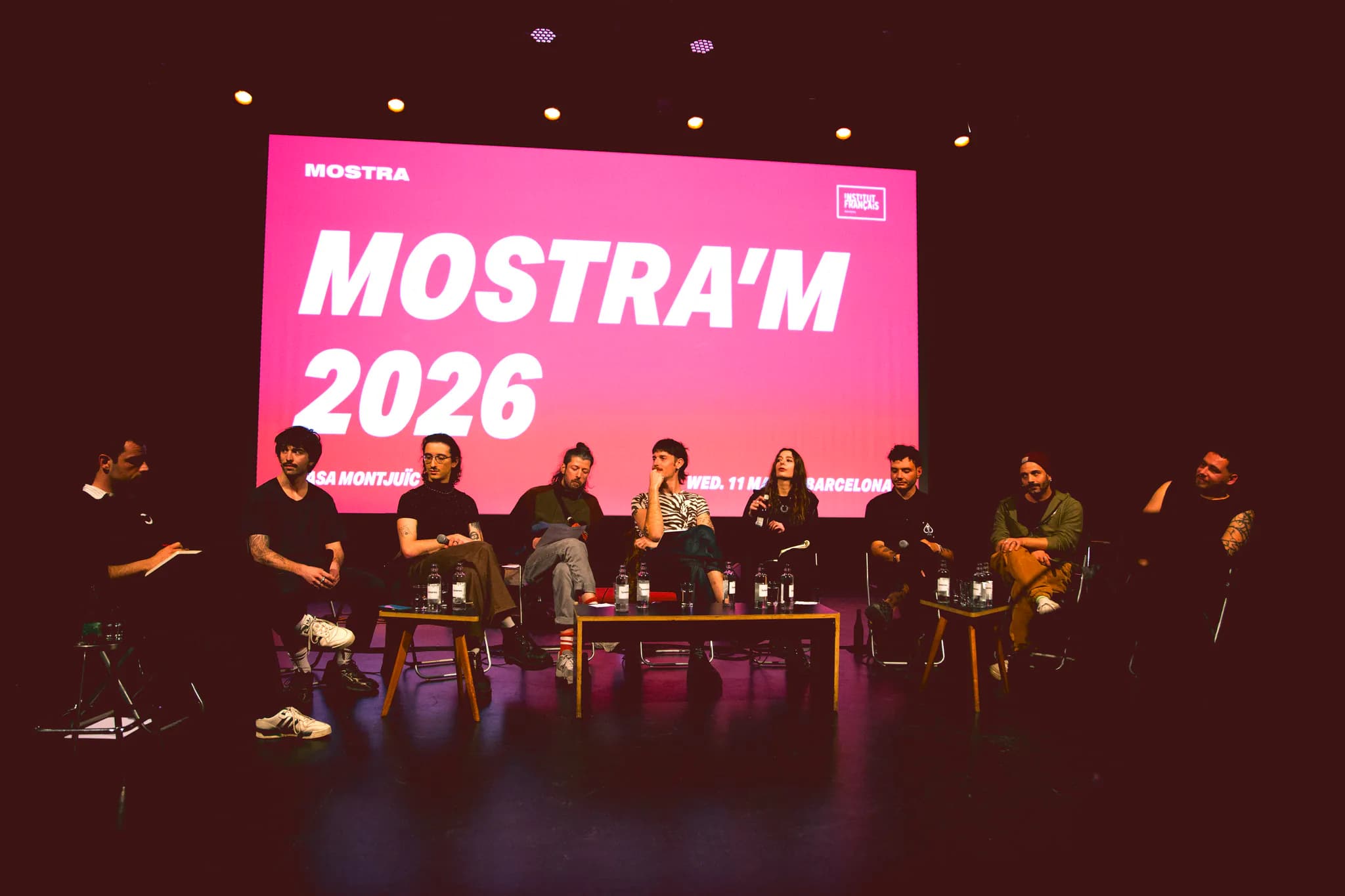
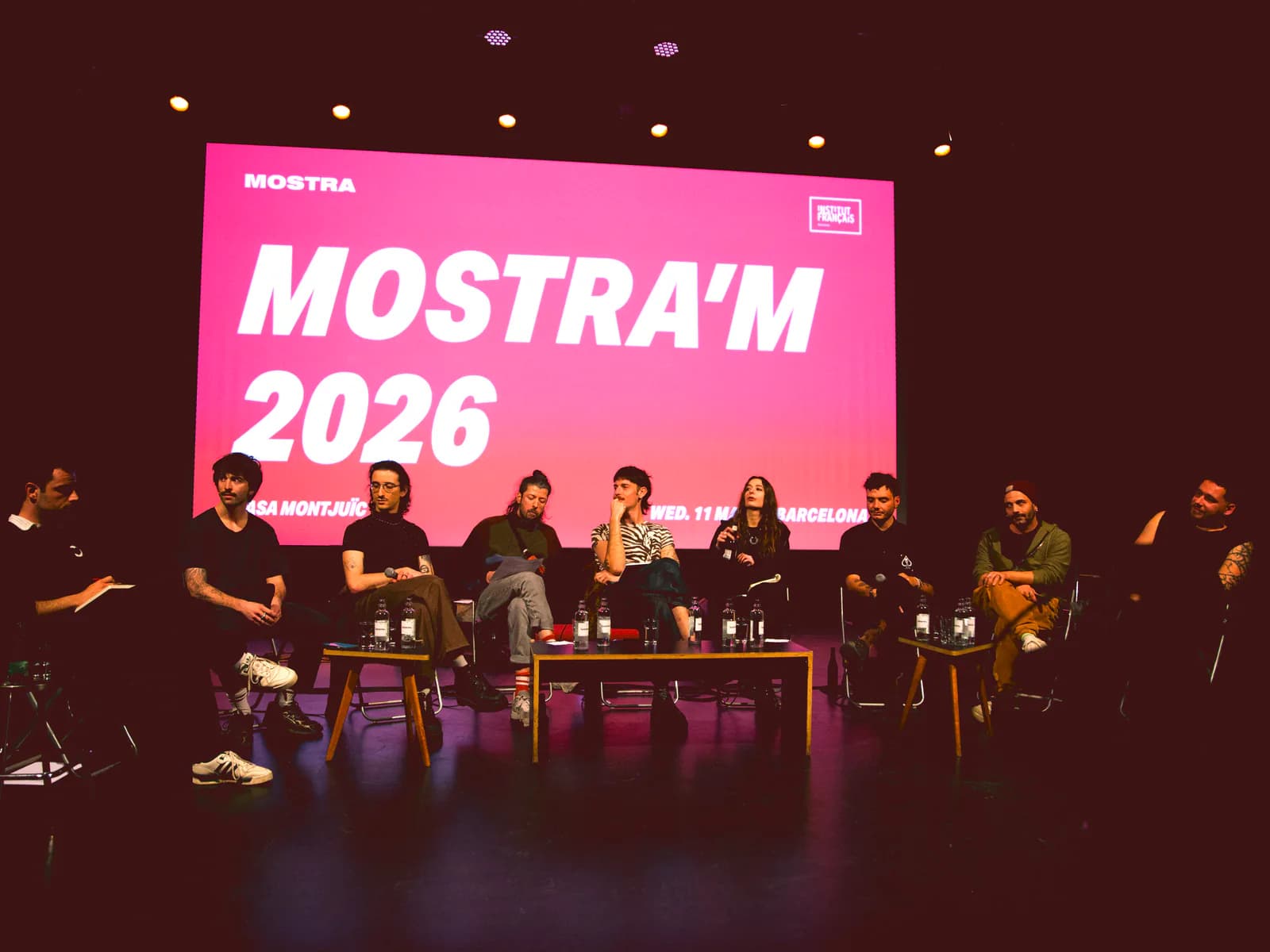
Mostra’m is the series of debates, seminars, talks and workshops we programme around the festival’s key themes on a local scale, but with a global outlook. These are reflective sessions held during festival week, addressing different topics in each edition and always responding to the three values that run through the whole project: local, inclusive and sustainable. The underlying idea is a simple one: to offer our audience something more than music, and to make room for thought, reflection and community.
The first sessions, in 2022
The first Mostra’m session was also the first activity in the festival’s history. In April 2022, at Hangar, we opened with a poster customisation workshop alongside L’Automàtica, the self-managed Barcelona collective of graphic designers, poets, artists and illustrators responsible, among many other things, for the Paralaxe Editions releases. We wanted the festival poster to be as alternative as the festival itself, and for the excuse to meet the team, our collaborators and other attendees to be a pair of scissors and a pile of magazines.
That first edition continued with two activities that set the tone for everything that followed. Observatori contra l’Homofòbia put together the round table ‘Mostrem-nos: experiences in the music industry’, in which six artists with different diversities from the local electronic scene shared experiences and reflections with two members of the organisation, moderated by Laura Boix and Mònica Sancho. And the workshop ‘Envisioning a Sustainable Mostra Festival’, led by Simon Lee, sustainability consultant and founder of ReRoot, together with DJs For Climate Action, was quite literally the starting point of our sustainability roadmap.
2023 and 2024: from Lynk&Co to the Castell
In 2023 the sessions moved to Lynk&Co and took over three consecutive evenings. The first, ‘Possible paths and alternatives in Barcelona’s music scene’, brought together Anna Cerdà (Paral·lel 62), Marta Mei (Centre Cultural Albareda), Ona Elena (Artista o Musa), Carles Llàcer and Hache Retamar (Acció Cultura Viva) and Fèlix Beltran (Mostra) to champion the models being built outside the established ones. The second, ‘A look at gender equality and music’, was the presentation of Asociación MIM’s second gender study on the Spanish music industry, with its president Carmen Zapata and its project coordinator Helena Bricio, moderated by our gender specialist, Iris Juarros. The third, ‘Exploring the intersection of sound, art and nature’, sat Grand River down with Patricia Usero and Marzia Matarese of Arquea Colectivo to discuss how nature runs through their artistic practices, moderated by Blanca Navarro.
In 2024 we returned to Hangar and also went up to the Castell de Montjuïc. Jokkoo Collective, the Barcelona-based arts collective devoted to exploring and disseminating the most contemporary creation from the experimental scenes of the African continent and its diaspora, led a conversation on migratory experiences followed by an electronic music workshop with a group of young people. Magui Dávila presented ‘Greatest Hits: autoeditions for the embodiment rhythms’, a journey through her publishing project laslindaspobres and through editorial projects crossing ecology, electronics, ecofeminism, queer politics and transfeminisms in ambient and techno. And on the final day we presented at the Castell the book ‘Atom™ — the non-conformist virtuoso’, by Ximo Noguera, with Uwe Schmidt himself in attendance, performing at the festival later that night.
2025, with Japan as guest country
In 2025, with Japan as guest country, the sessions hosted a conversation devoted to the Japanese scene moderated by Kentaro Terajima, who was also behind the festival’s art direction in its early years.
2026, with France as guest country
And in 2026, with France as a guest country, Mostra’m programmed two special activities, ‘French Affair’ and ‘In the Name of <3’, in a year when the guest country extended across the festival’s entire ecosystem, from the musical programme to the exhibitors at the Fira.
Critical reflection and the local scene
The sessions have also been where we have opened up spaces for critical reflection that do not fit on a dancefloor. Charlie C. Thomas’s performative lecture, for instance, traced the evolution of the heart symbol — the very emblem of the festival — from its association with love to its use in digital culture and capitalism, in order to examine how certain far-right movements in Europe and the United States have appropriated that affective imagery to legitimise discourses of exclusion under an appearance of care and belonging.
Programming local collectives and cultural agents from different disciplines within Mostra’m has always been a priority when organising any of our activities. To date we have collaborated with or welcomed to the sessions people from L’Automàtica, Observatori contra l’Homofòbia, Sin Sync, In-Edit, Centre Cultural La Sedeta, Barcelona Districte Cultural, Paral·lel 62, Centre Cultural Albareda, Artista o Musa, Acció Cultura Viva, Asociación MIM, Arquea Colectivo, Jokkoo Collective, Canino, HOC Radio, RBL, Sub Radio, La Veïnal and Scanner FM.
Free to attend
All the sessions are free to attend and take place outside the dance spaces, in cultural institutions and venues across the city.
The other heartbeats